Division B
Acceptable Solutions
Part 4 — Structural Design
Section 4.1. Structural Loads and Procedures
4.1.1. General
(See User’s Guide - NBC 2010, Structural Commentaries (Part 4 of Division B).)
4.1.1.1. Scope
 The scope of this Part shall be as described in Subsection 1.3.3. of Division A.
4.1.1.2. Definitions
Words that appear in italics in this Part are defined in Article 1.4.1.2. of Division A. 4.1.1.3. Design Requirements
Buildings and their structural members and connections, including formwork and falsework, shall be designed
to have sufficient structural capacity and structural integrity to
safely and effectively resist all loads, effects of loads and influences
that may reasonably be expected, having regard to the expected service
life of buildings, and shall in any case satisfy the requirements of this Section. (See Appendix A.) Buildings and their structural members shall be designed for serviceability, in accordance with Articles 4.1.3.4., 4.1.3.5. and 4.1.3.6. (See Appendix A.)

4.1.1.4. Structural Drawings and Related Documents
Structural drawings and related documents shall conform to the appropriate requirements of Section 2.2. of Division C. (See Subsection 2.2.4. of Division C.)
4.1.1.5. Design Basis
Except as provided in Sentence (2), buildings and their structural members shall be designed in conformance with the procedures and practices
provided in this Part.
Provided the design is carried out by a person especially qualified in the specific methods applied and provided the design demonstrates
a level of safety and performance in accordance with the requirements
of Part 4, buildings and their structural components falling within the scope of Part 4 that are not amenable
to analysis using a generally established theory may be designed by4.1.2. Specified Loads and Effects
(See User’s Guide - NBC 2010, Structural Commentaries (Part 4 of Division B).)
4.1.2.1. Loads and Effects
(See Appendix A.)Except as provided in Article 4.1.2.2., the following categories of loads, specified loads and effects shall be taken into
consideration in the design of a building and its structural members and connections:  LXClive load exclusive of crane loads,
 Minimum specified values of the loads described in Sentence (1), as set forth in Subsections 4.1.4. to 4.1.8., shall be increased to account
for dynamic effects where applicable.
For the purpose of determining specified loads S, W or E in Subsections 4.1.6., 4.1.7. and 4.1.8., buildings shall be assigned an Importance Category based on intended use and occupancy, in accordance with Table 4.1.2.1. (See Appendix A.)
Minimum specified values of the loads described in Sentence (1), as set forth in Subsections 4.1.4. to 4.1.8., shall be increased to account
for dynamic effects where applicable.
For the purpose of determining specified loads S, W or E in Subsections 4.1.6., 4.1.7. and 4.1.8., buildings shall be assigned an Importance Category based on intended use and occupancy, in accordance with Table 4.1.2.1. (See Appendix A.)| Table 4.1.2.1. Importance Categories for Buildings Forming part of Sentence 4.1.2.1.(3) | |
|
Use and Occupancy | Importance Category |
|
Buildings that represent a low direct or indirect hazard to human life in the event of failure, including: |
Low(1) |
|
All buildings except those listed in Importance Categories Low, High and Post-disaster |
Normal |
|
Buildings that are likely to be used as post-disaster shelters, including buildings whose primary use is:
|
High |
|
Post-disaster buildings are buildings that are essential to the provision of services in the event of a disaster, and include:
|
Post-disaster |
| Notes to Table 4.1.2.1.: | |
|
|
|
| (1) | See Appendix A. |
| (2) | See A-1.4.1.2.(1), Post-disaster Buildings, in Appendix A of Division A. |
4.1.2.2. Loads Not Listed
Where a building or structural member can be expected to be subjected to loads, forces or other effects
not listed in Article 4.1.2.1., such effects shall be taken into account in the design based on the most appropriate information
available.
4.1.3. Limit States Design
(See Appendix A.)4.1.3.1. Definitions
In this Subsection, the term4.1.3.2. Strength and Stability
A building and its structural components shall be designed to have sufficient strength and stability so that
the factored resistance, φR, is greater than or equal to the effect
of factored loads, which shall be determined in accordance with Sentence 4.1.3.2.(2). Except as provided in Sentence (3), the effect of factored loads for a building or structural component shall be determined in accordance with the requirements of this Article and the following load combination cases, the applicable combination being that which results in the most critical effect:(See Appendix A.)Other load combinations that must also be considered are the principal loads acting with the companion loads taken as zero.Where the effects due to lateral earth pressure, H, restraint effects from pre-stress, P, and imposed deformation, T, affect the structural safety, they shall be taken into account in the calculations, with load factors of 1.5,
1.0 and 1.25 assigned to H, P and T respectively.
(See Appendix A.) Except as provided in Sentence 4.1.8.16.(1), the counteracting factored dead load—0.9D in load combination cases 2, 3 and 4 and 1.0D in load combination case 5 in Table 4.1.3.2.A, and 0.9D in load combination cases 1 to 5 and 1.0D in load combination case 6 in Table 4.1.3.2.B—shall be used when the dead load acts to resist overturning, uplift, sliding, failure due to stress reversal, and to determine anchorage requirements and the factored
resistance of members. (See Appendix A.) The principal-load factor 1.5 for live loads L in Table 4.1.3.2.A and LXC in Table 4.1.3.2.B may be reduced to 1.25 for liquids in tanks. The companion-load factor 0.5 for live loads L in Table 4.1.3.2.A and LXC in Table 4.1.3.2.B shall be increased to 1.0 for storage areas, and equipment areas and service rooms referred to in Table 4.1.5.3.| Table 4.1.3.2.A Load Combinations Without Crane Loads for Ultimate Limit StatesForming part of Sentences 4.1.3.2.(2) and (5) to (10) | ||
| Case |
Load Combination(1) | |
| Principal Loads |
Companion Loads |
|
| 1 |
1.4D |
— |
| 2 |
0.5S(6) or 0.4W |
|
| 3 | ||
| 4 |
0.5L |
|
| 5 | ||
| Notes to Table 4.1.3.2.A: | |
|
|
|
| (1) | See Sentences 4.1.3.2.(2), (3) and (4). |
| (2) | See Sentence 4.1.3.2.(9). |
| (3) | See Sentence 4.1.3.2.(8). |
| (4) | See Sentence 4.1.3.2.(5). |
| (5) | See Sentence 4.1.3.2.(6). |
| (6) | See Article 4.1.5.5. |
| (7) | See Sentence 4.1.3.2.(7). |
| (8) | See Sentence 4.1.3.2.(10). |
| Table 4.1.3.2.B Load Combinations With Crane Loads for Ultimate Limit States Forming part of Sentences 4.1.3.2.(2), (5) to (8), and (10) | ||
| Case |
Load Combination(1) | |
| Principal Loads | Companion Loads | |
| 1 |
1.0S(4) or 0.4W |
|
| 2 |
0.5S(4) or 0.4W |
|
| 3 | ||
| 4 | ||
| 5 | — | |
| 6 | ||
| Notes to Table 4.1.3.2.B: | |
|
|
|
| (1) | See Sentences 4.1.3.2.(2), (3) and (4). |
| (2) | See Sentence 4.1.3.2.(8). |
| (3) | See Sentence 4.1.3.2.(5). |
| (4) | See Article 4.1.5.5. |
| (5) | See Sentence 4.1.3.2.(6). |
| (6) | See Sentence 4.1.3.2.(7). |
| (7) | Side thrust due to cranes need not be combined with full wind load. |
| (8) | See Sentence 4.1.3.2.(10). |
Except as provided in Sentence (9), the load factor 1.25 for dead load, D, for soil, superimposed earth, plants and trees given in Tables 4.1.3.2.A and 4.1.3.2.B shall be increased to 1.5, except that when the soil depth exceeds 1.2 m, the factor may be reduced to 1 + 0.6/hs but not less than
1.25, where hs is the depth of soil in metres supported by the structure.
A principal-load factor of 1.5 shall be applied to the weight of saturated soil used in load combination case 1 of Table 4.1.3.2.A.Earthquake load, E, in load combination cases 5 of Table 4.1.3.2.A and 6 of Table 4.1.3.2.B includes horizontal earth pressure due to earthquake determined in accordance with Sentence 4.1.8.16.(4). Provision shall be made to ensure adequate stability of the structure as a whole and adequate lateral, torsional and local stability
of all structural parts.
Sway effects produced by vertical loads acting on the structure in its displaced configuration shall be taken into account in the
design of buildings and their structural members.
4.1.3.3. Fatigue
A building and its structural components, including connections, shall be checked for fatigue failure under
the effect of cyclical loads, as required in the standards listed
in Section 4.3. (See Appendix A.) Where vibration effects, such as resonance and fatigue resulting from machinery and equipment, are likely to be significant, a dynamic
analysis shall be carried out. (See Appendix A.) 4.1.3.4. Serviceability
A building and its structural components shall be checked for serviceability limit states as defined in Clause 4.1.3.1.(1)(a) under the effect of service loads for serviceability criteria specified or recommended in Articles 4.1.3.5. and 4.1.3.6. and in the standards listed in Section 4.3. (See Appendix A.) 4.1.3.5. Deflection
In proportioning structural members to limit serviceability problems resulting from deflections, consideration shall be given
toThe lateral deflection of buildings due to service wind and gravity loads shall be checked to ensure that structural elements and non-structural elements whose nature
is known at the time the structural design is carried out will not
be damaged.
Except as provided in Sentence (4), the total drift per storey under service wind and gravity loads shall not exceed 1/500 of the storey height unless other drift limits are specified in the design standards referenced in Section 4.3. (See Appendix A.) The deflection limits required in Sentence (3) do not apply to industrial buildings or sheds if experience has proven that greater movement will have no significant adverse effects on the strength and function of the building. The building structure shall be designed for lateral deflection due to E,
in accordance with Article 4.1.8.13.4.1.3.6. Vibration
Floor systems susceptible to vibration shall be designed so that vibrations will have no significant adverse effects on the intended occupancy of the building. (See Appendix A.)Where the fundamental vibration frequency of a structural system supporting an assembly occupancy used for rhythmic activities, such as dancing, concerts, jumping exercises
or gymnastics, is less than 6 Hz, the effects of resonance
shall be investigated by means of a dynamic analysis. (See Appendix A.) A building susceptible to lateral vibration under wind load shall be designed in accordance with Article 4.1.7.2. so that the vibrations will have no significant adverse effects on the intended use and occupancy of the building. (See Appendix A.) 4.1.4. Dead Loads
4.1.4.1. Dead Loads
Except as provided in Sentence (5), in areas of a building where partitions other than permanent partitions are shown on the drawings, or where partitions might be added in the future, allowance shall be made for the weight of such partitions. The partition weight allowance referred to in Sentence (2) shall be determined from the actual or anticipated weight of the partitions placed in any probable position, but shall be not less than 1 kPa over the area of floor being considered. Partition loads used in design shall be shown on the drawings as provided in Clause 2.2.4.3.(1)(d) of Division C. In cases where the dead load of the partition is counteractive, the load allowances referred to in Sentences (2) and (3) shall not be included in the design calculations.
Except for structures where the dead load of soil is part of the load-resisting system, where the dead load due to soil, superimposed earth, plants and trees is counteractive, it shall not be included in the design calculations. (See Appendix A.) 4.1.5. Live Loads Due to Use and Occupancy
(See User’s Guide - NBC 2010, Structural Commentaries (Part 4 of Division B).)
4.1.5.1. Loads Due to Use of Floors and Roofs
Except as provided in Sentence (2), the specified live load on an area of floor or roof depends on the intended use and occupancy, and shall not be less than either the uniformly distributed load patterns listed in Article 4.1.5.3., the loads due to the intended use and occupancy, or the concentrated loads listed in Article 4.1.5.9., whichever produces the most critical effect. (See Appendix A.)For buildings in the Low Importance Category as described in Table 4.1.2.1., a factor of 0.8 may be applied to the live load. 4.1.5.2. Uses Not Stipulated
Except as provided in Sentence (2), where the use of an area of floor or roof is not provided for in Article 4.1.5.3., the specified live loads due to the use and occupancy of the area shall be determined from an analysis of the loads resulting from the weight ofFor buildings in the Low Importance Category as described in Table 4.1.2.1., a factor of 0.8 may be applied to the live load. 4.1.5.3. Full and Partial Loading
The uniformly distributed live load shall be not less than the value listed in Table 4.1.5.3., which may be reduced as provided in Article 4.1.5.8., applied uniformly over the entire area or on any portions of the area, whichever produces the most critical effects in the members
concerned.
| Table 4.1.5.3. Specified Uniformly Distributed Live Loads on an Area of Floor or Roof Forming part of Sentence 4.1.5.3.(1) | |
| Use of Area of Floor or Roof | Minimum Specified Load, kPa |
| Assembly Areas | 4.8 |
|
a) Except for the areas listed under
b), c), |
|
| Arenas(1) (areas without fixed seats that have
backs) | |
| Auditoria | |
| Churches (areas without fixed seats that have
backs) | |
| Dance floors | |
| Dining areas(2) | |
| Foyers and entrance halls | |
| Grandstands(1) (areas without fixed seats that have
backs), reviewing stands and bleachers |
|
| Gymnasia | |
| Lecture halls(1) (areas without fixed seats that have backs) | |
| Museums | |
| Promenades | |
| Rinks | |
| Stadia(1) (areas without fixed seats that have
backs) | |
| Theatres(areas without fixed seats that have backs) | |
| Other areas with similar uses | |
|
b) Classrooms |
2.4 |
|
|
|
| Arenas | |
| Grandstands | |
| Stadia | |
|
|
|
| Churches | |
| Lecture halls(1) | |
| Theatres | |
|
|
|
| Attics(1) | |
| Accessible by a stairway in residential occupancies only | 1.4 |
| Having limited accessibility so that there is no storage of equipment or material | 0.5 |
| Balconies | |
| Exterior | 4.8 |
| Interior and mezzanines that could be used by an assembly of people as a viewing area(1) | 4.8 |
| Interior and mezzanines other than above | |
| Corridors, lobbies and aisles(1) | |
| Other than those listed below | 4.8 |
| Not more than 1 200 mm in width and all upper floor corridors of residential areas only of apartments, hotels and motels (that cannot be used by an assembly of people as a viewing area)(1) | |
|
Equipment areas and service rooms including |
3.6(4) |
| Generator rooms | |
| Mechanical equipment exclusive of elevators | |
| Machine rooms | |
| Pump rooms | |
| Transformer vaults | |
| Ventilating or air-conditioning equipment | |
|
Exits and fire escapes |
4.8 |
| Factories |
6.0(4) |
| Footbridges | 4.8 |
| Garages for | |
| Vehicles not exceeding 4 000 kg gross weight | 2.4 |
| Vehicles exceeding 4 000 kg but not exceeding 9 000 kg gross
weight | 6.0 |
| Vehicles exceeding 9 000 kg gross weight |
12.0 |
| Kitchens (other than residential) | 4.8 |
| Libraries | |
| Stack rooms | 7.2 |
| Reading and study rooms | 2.9 |
| Office areas (not including record storage and computer rooms) located in | |
| Basement and the first storey | 4.8 |
| Floors above the first storey | 2.4 |
| Operating rooms and laboratories | 3.6 |
| Patients' bedrooms | 1.9 |
| Recreation areas that cannot be used for assembly purposes including | 3.6 |
| Billiard rooms | |
| Bowling alleys | |
| Pool rooms | |
| Residential areas (within the scope of Article 1.3.3.2. of Division A) | |
| Sleeping and living quarters in apartments, hotels, motels, boarding schools and colleges | 1.9 |
| Residential areas (within the scope of Article 1.3.3.3. of Division A) | |
| Bedrooms |
1.9 |
| Other areas | 1.9 |
| Stairs within dwelling units | 1.9 |
| Retail and wholesale areas | 4.8 |
| Roofs | |
|
Sidewalks and driveways over areaways and basements |
|
| Storage areas |
4.8(4) |
| Toilet areas | 2.4 |
| Underground slabs with earth cover | |
| Warehouses |
4.8(4) |
| Notes to Table 4.1.5.3.: | |
|
|
|
| (1) | See Appendix A. |
| (2) | See Article 4.1.5.6. |
| (3) | See Article 4.1.5.4. |
| (4) | See Sentence 4.1.5.1.(1). |
| (5) | See Article 4.1.5.5. |
4.1.5.4. Loads for Occupancy Served
The following shall be designed to carry not less than the specified load required for the occupancy they serve, provided they cannot be used by an assembly of people as a viewing
area:4.1.5.5. Loads on Exterior Areas
(See Appendix A.)Exterior areas accessible to vehicular traffic shall be designed for their intended use, including the weight of firefighting equipment,
but not for less than the snow and rain loads prescribed in Subsection 4.1.6.Except as provided in Sentences (3) and (4), roofs shall be designed for either the uniform live loads specified in Table 4.1.5.3., the concentrated live loads listed in Table 4.1.5.9., or the snow and rain loads prescribed in Subsection 4.1.6., whichever produces the most
critical effects in the members concerned.
Exterior areas accessible to pedestrian traffic, but not vehicular traffic, shall be designed for their intended use, but not for less
than the greater ofRoof parking decks shall be designed for either the uniformly distributed live loads specified in Table 4.1.5.3., the concentrated live loads listed in Table 4.1.5.9., or the roof snow load, whichever produces the most critical effect in the members concerned.
4.1.5.6. Loads for Dining Areas
The minimum specified live load listed in Table 4.1.5.3. for dining areas may be reduced to 2.4 kPa for areas in buildings that are being converted to dining areas, provided that the floor area does not exceed 100 m2 and the dining area will not be used for other assembly purposes, including dancing.
4.1.5.7. More Than One Occupancy
Where an area of floor or roof is intended for 2 or more occupancies at different times, the value to be used from Table 4.1.5.3. shall be the greatest value for any of the occupancies concerned. 4.1.5.8. Variation with Tributary Area
(See Appendix A.)An area used for assembly occupancies designed for a live load of less than 4.8 kPa and roofs designed for the minimum loading specified in Table 4.1.5.3. shall have no reduction for tributary area.
Where a structural member supports a tributary area of a floor or a roof, or a combination thereof, that is greater than 80 m2 and either used for assembly occupancies designed for a live load of 4.8 kPa or more, or used for storage, manufacturing, retail stores, garages or as a footbridge, the specified live load due to use and occupancy is the load specified in Article 4.1.5.3. multiplied by 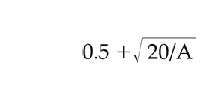 Where a structural member supports a tributary area of a floor or a roof, or a combination thereof, that is greater than 20 m2 and used
for any use or occupancy other than those indicated in Sentences (1) and (2), the specified live load due to use and occupancy is the load specified in Article 4.1.5.3. multiplied by
Where a structural member supports a tributary area of a floor or a roof, or a combination thereof, that is greater than 20 m2 and used
for any use or occupancy other than those indicated in Sentences (1) and (2), the specified live load due to use and occupancy is the load specified in Article 4.1.5.3. multiplied by
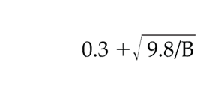 Where the specified live load for a floor is reduced in accordance with Sentence 4.1.5.8.(2) or (3), the structural drawings shall indicate that a live load reduction factor for tributary area has been applied.
4.1.5.9. Concentrated Loads
The specified live load due to possible concentrations of load resulting from the use of an area of floor
or roof shall not be less than that listed in Table 4.1.5.9. applied over the loaded area noted and located so as to cause maximum effects, except that for occupancies not listed in Table 4.1.5.9., the concentrations of load shall be determined in accordance with Article 4.1.5.2.| Table 4.1.5.9. Specified Concentrated Live Loads on an Area of Floor or Roof Forming part of Sentence 4.1.5.9.(1) | ||
| Area of Floor or Roof | Minimum Specified Concentrated Load, kN | Loaded Area, mm x mm |
| Roof surfaces | 1.3 | 200 x 200 |
| Floors of classrooms | 4.5 | 750 x 750 |
| Floors of offices, manufacturing buildings, hospital wards and stages | 9.0 | 750 x 750 |
| Floors and areas
used by vehicles not exceeding
4 000 kg gross weight |
18 | 120 x 120 |
| Floors and areas
used by vehicles exceeding
4 000 kg but not exceeding 9 000 kg gross weight |
36 | 120 x 120 |
| Floors and areas used by vehicles exceeding 9 000 kg gross weight | 54(1) |
|
| Driveways and sidewalks over areaways and basements | 54(1) |
|
| Notes to Table 4.1.5.9.: | |
|
|
|
| (1) | See Appendix A. |
4.1.5.10. Sway Forces in Assembly Occupancies
The floor assembly and other structural elements that support fixed seats in any building used for assembly occupancies accommodating large numbers of people at one time, such as grandstands, stadia and theatre balconies, shall be designed to resist a horizontal force equal to not less than 0.3 kN for each metre length
of seats acting parallel to each row of seats, and not less than 0.15 kN for each metre length of seats acting at right angles
to each row of seats, based on the assumption that these forces are
acting independently of each other.
4.1.5.11. Crane-Supporting Structures and Impact of Machinery and Equipment
(See Appendix A.)The minimum specified load due to equipment, machinery or other objects that may produce impact shall be the sum of the weight of
the equipment or machinery and its maximum lifting capacity, multiplied
by an appropriate factor listed in Table 4.1.5.11.Crane-supporting structures shall be designed for the appropriate load combinations listed in Article 4.1.3.2. per cent
 of the sum of the weights of the lifted load and the crane trolley (excluding other parts of the
crane).
of the sum of the weights of the lifted load and the crane trolley (excluding other parts of the
crane).
The force described in Sentence (3) shall be equally distributed on each side of the runway and shall be assumed to act in either direction.
per cent of the maximum wheel loads of the crane.
| Table 4.1.5.11. Factors for the Calculation of Impact Loads Forming part of Sentence 4.1.5.11.(1) | |
| Cause of Impact | Factor |
| Operation of cab or radio-operated cranes | 1.25 |
| Operation of pendant or hand-operated cranes | 1.10 |
| Operation of elevators | |
| Supports for light machinery, shaft or motor-driven | 1.20 |
| Supports for reciprocating machinery (e.g. compressors) | 1.50 |
| Supports for power-driven units (e.g. piston engines) | 1.50 |
| Notes to Table 4.1.5.11.: | |
|
|
|
| (1) | See ASME A17.1/CSA B44, “Safety Code for Elevators and Escalators.” |
4.1.5.12. Bleachers
Bleacher seats shall be designed for a uniformly distributed live load of 1.75 kN for each linear metre or for a concentrated load of 2.2 kN distributed
over a length of 0.75 m, whichever produces the most
critical effect on the supporting members.
Bleachers shall be checked by the erector after erection to ensure that all structural members, including bracing specified in
the design, have been installed.
Telescopic bleachers shall be provided with locking devices to ensure stability while in use.
4.1.5.13. Helicopter Landing Areas
Helicopter landing areas on roofs shall be constructed in conformance with the requirements for heliports contained in the “Canadian Aviation Regulations – Part III,” published by Transport
Canada.
4.1.5.14. Loads on Guards
(See Appendix A.)The minimum specified horizontal load applied inward or outward at the minimum required height of every required guard shall befor open viewing stands without fixed seats and for means of egress in grandstands, stadia, bleachers and arenas,
Individual elements within the guard, including solid panels and pickets, shall be designed for a load of 0.5 kN applied over an area of 100 mm by 100 mm located at any point in the element or elements
so as to produce the most critical effect.
The loads required in Sentence (2) need not be considered to act simultaneously with the loads provided for in Sentences (1) and (4). The minimum specified load applied vertically at the top of every required guard shall be 1.5 kN/m and need not be considered to act simultaneously with
the horizontal load provided for in Sentence (1). 4.1.5.15. Loads on Vehicle Guardrails
Vehicle guardrails shall be designed for a concentrated load of 22 kN applied horizontally outward at any point 500 mm above the floor surface. (See Appendix A.) 4.1.5.16. Loads on Walls Acting As Guards
Where the floor elevation on one side of a wall, including a wall around a shaft, is more than 600 mm higher than
the elevation of the floor or ground on the other side, the wall shall
be designed to resist the appropriate lateral design loads prescribed
elsewhere in this Section or 0.5 kPa, whichever produces
the more critical effect.
4.1.5.17. Firewalls
(See Appendix A.)Firewalls shall be designed to resist the maximum effect due toUnder fire conditions, where the fire-resistance rating of the structure is less than that of the firewall,4.1.5.18. Loads for Building Maintenance
4.1.6. Loads Due to Snow and Rain
(See User's Guide - NBC 2010, Structural Commentaries (Part 4 of Division B).)
4.1.6.1. Specified Load Due to Rain or to Snow and Associated Rain
The specified load on a roof or any other building surface subject to snow and associated rain shall be the snow load specified in Article 4.1.6.2., or the rain load specified in Article 4.1.6.4., whichever produces the more critical effect.
4.1.6.2. Specified Snow Load
(See Appendix A.) where
where
| Table 4.1.6.2. Importance Factor for Snow Load, IS Forming part of Sentence 4.1.6.2.(1) | ||
| Importance Category |
Importance Factor, Is |
|
| ULS | SLS | |
| Low | 0.8 | 0.9 |
| Normal | 1 | 0.9 |
| High | 1.15 | 0.9 |
| Post-disaster | 1.25 | 0.9 |
The basic roof snow load factor, Cb, shall be 0.8, except that for large roofs it shall beExcept as provided for in Sentence (4), the wind exposure factor, Cw, shall be 1.0. For buildings in the Low and Normal Importance Categories as set out in Table 4.1.2.1., the wind exposure factor given in Sentence (3) may be reduced to 0.75, or to 0.5 in exposed areas north of the treeline, whereExcept as provided for in Sentences (6) and (7), the slope factor, Cs, shall beThe slope factor, Cs, for unobstructed slippery roofs where snow and ice can slide completely off the roof shall beThe slope factor, Cs, shall be 1.0 when used in conjunction with shape factors for increased snow loads as given in Clauses (8)(b) and (e). The shape factor, Ca, shall be 1.0, except that where appropriate for the shape of the roof, it shall be assigned other
values that account for4.1.6.3. Full and Partial Loading
A roof or other building surface and its structural members subject to loads due to snow accumulation
shall be designed for the specified load given in Sentence 4.1.6.2.(1), distributed over the entire loaded area. In addition to the distribution mentioned in Sentence (1), flat roofs and shed roofs, gable roofs of 15° slope or less, and arched or curved roofs
shall be designed for the specified uniform snow load indicated in Sentence 4.1.6.2.(1), which shall be calculated using Ca = 1.0, distributed on any one portion of the loaded area and half of
this load on the remainder of the loaded area, in such a way as to
produce the most critical effects on the member concerned. (See Appendix A.)4.1.6.4. Specified Rain Load
Except as provided in Sentence (4), the specified load, S, due to the accumulation of rainwater on a surface whose position, shape and
deflection under load make such an accumulation possible, is that
resulting from the one-day rainfall determined in conformance with Subsection 1.1.3. and applied over the horizontal projection
of the surface and all tributary surfaces. (See Appendix A.) The provisions of Sentence (1) apply whether or not the surface is provided with a means of drainage, such
as rainwater leaders.
Except as provided in Sentence 4.1.6.2.(1), loads due to rain need not be considered to act simultaneously with loads due
to snow. (See Appendix A.) Where scuppers are provided and where the position, shape and deflection of the loaded surface make an accumulation of rainwater
possible, the loads due to rain shall be the lesser of either the
one-day rainfall determined in conformance with Subsection 1.1.3. or a depth of rainwater equal to 30 mm above the level of the scuppers, applied over the horizontal projection
of the surface and tributary areas.
4.1.7. Wind Load
(See User's Guide - NBC 2010, Structural Commentaries (Part 4 of Division B).)4.1.7.1. Specified Wind Load
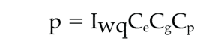
The specified external pressure or suction due to wind on part or all of a surface of a building shall be calculated using the formula
| Table 4.1.7.1. Importance Factor for Wind Load, IW Forming part of Sentences 4.1.7.1.(1) and (3) | ||
| Importance Category |
Importance Factor, IW |
|
| ULS | SLS | |
| Low | 0.8 | 0.75 |
| Normal | 1 | 0.75 |
| High | 1.15 | 0.75 |
| Post-disaster | 1.25 | 0.75 |
The net wind load for the building as a whole shall be the algebraic difference of the loads on the windward and leeward surfaces, and in
some cases, may be calculated as the sum of the products of the external pressures
or suctions and the areas of the surfaces over which they are averaged as provided
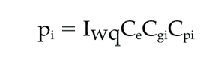
in Sentence (1). (See Appendix A.)The net specified pressure due to wind on part or all of a surface of a building shall be the algebraic difference of the external pressure or suction as provided in Sentence (1) and the specified internal pressure or suction due to wind calculated using the
following formula:
 The reference velocity pressure, q, shall be the appropriate value determined in conformance with Subsection 1.1.3., based on a probability of being
exceeded in any one year of 1 in 50.
The exposure factor, Ce, shall be20 times the height of the building, whichever is greater, h being the reference height above grade in metres for the surface or part of the surface (see Appendix A), 20 times the height of the building from a change in terrain conditions, whichever is greater, provided an appropriate
interpolation method is used (see Appendix A), or The gust effect factor, Cg, shall be one of the following values:
The reference velocity pressure, q, shall be the appropriate value determined in conformance with Subsection 1.1.3., based on a probability of being
exceeded in any one year of 1 in 50.
The exposure factor, Ce, shall be20 times the height of the building, whichever is greater, h being the reference height above grade in metres for the surface or part of the surface (see Appendix A), 20 times the height of the building from a change in terrain conditions, whichever is greater, provided an appropriate
interpolation method is used (see Appendix A), or The gust effect factor, Cg, shall be one of the following values:
4.1.7.2. Dynamic Effects of Wind
Except as provided in Sentence (2), buildings whose height is greater than 4 times their minimum effective width, which is defined in Sentence (3), or greater than 60 m, and buildings whose lowest natural frequency is less than 1 Hz, as determined by rational analysis (see Appendix A), shall be designedBuildings whose lowest natural frequency is less than ¼ Hz, as determined by rational analysis,
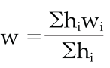
shall be designed by experimental methods in accordance with Clause (1)(a). (See Appendix A.)The effective width, w, of a building shall be calculated using
4.1.7.3. Full and Partial Loading
per cent of the load removed from any portion of the area, per cent of their full value, and per cent of these loads removed from any portion of the area.
4.1.7.4. Interior Walls and Partitions
In the design of interior walls and partitions, due consideration shall be given to differences in air pressure on opposite sides of the wall or partition which may result from4.1.7.5. Exterior Wall Air Barrier
4.1.8. Earthquake Load and Effects
(See User's Guide - NBC 2010, Structural Commentaries (Part 4 of Division B).)4.1.8.1. Analysis
The deflections and specified loading due to earthquake motions shall be determined according to the requirements in this Subsection,
except that the requirements in this Subsection need not be considered
in design if S(0.2), as defined in Sentence 4.1.8.4.(7), is less than or equal to 0.12.
4.1.8.2. Notation
Sentence 4.1.8.18.(1),Sentence 4.1.8.18.(1),Sentence 4.1.8.18.(1),per cent of the theoretical maximum,reversed cyclic inelastic behaviour, as given in Article 4.1.8.9.,Sentence 4.1.8.18.(1),Sentence 4.1.8.4.(7),per cent damped spectral response acceleration, expressed as a ratio to gravitational acceleration, for a period of T, as defined in Sentence 4.1.8.4.(1),Ved= lateral earthquake design elastic force at the base of the structure, as determined by Article 4.1.8.12.,Article 4.1.8.18.,per cent of the design snow load specified in Subsection 4.1.6., plus 60 per cent of the storage load for areas used for storage, except that storage garages need not be considered storage areas, and the full contents of any tanks (see Appendix A),
4.1.8.3. General Requirements
The building shall be designed to meet the requirements of this Subsection and of the design standards referenced in Section 4.3.Structures shall be designed with a clearly defined load path, or paths, that will transfer the inertial forces generated in an earthquake
to the supporting ground.
The structure shall have a clearly defined Seismic Force Resisting System(s) (SFRS), as defined in Article 4.1.8.2.per cent of the earthquake loads and their effects. (See Appendix A.)
All structural framing elements not considered to be part of the SFRS must be investigated and shown to behave elastically or to
have sufficient non-linear capacity to support their gravity loads
while undergoing earthquake-induced deformations calculated from the
deflections determined in Article 4.1.8.13.Stiff elements that are not considered part of the SFRS, such as concrete, masonry, brick or pre-cast walls or panels, shall beper cent,
Structural modelling shall be representative of the magnitude and spatial distribution of the mass of the building and of the stiffness of all elements of the SFRS, including stiff elements that are not
separated in accordance with Sentence (6), and shall account for4.1.8.4. Site Properties
per cent damped spectral response acceleration values, Sa(T), for the reference ground conditions (Site
Class C in Table 4.1.8.4.A) for periods T of 0.2 s, 0.5 s, 1.0 s, and 2.0 s, shall
be determined in accordance with Subsection 1.1.3. and
are based on a 2 per cent probability of exceedance in 50 years.
| Table 4.1.8.4.A Site Classification for Seismic Site Response Forming part of Sentences 4.1.8.4.(1) to (3) | ||||
| Site Class | Ground Profile Name | Average Properties in Top 30 m, as per Appendix A | ||
|
Average Shear Wave Velocity, V̅s (m/s) |
Average Standard Penetration Resistance, N̅60 |
Soil Undrained Shear Strength, su |
||
| A |
V̅s > 1500 |
n/a | n/a | |
| B |
760 < V̅s ≤ 1500 |
n/a | n/a | |
| C |
360 < V̅s < 760 |
N̅60 > 50 |
su > 100 kPa |
|
| D |
Stiff soil |
180 < V̅s < 360 |
15 ≤ N̅60 ≤ 50 |
50 kPa < su ≤ 100 kPa |
| E |
Soft soil |
V̅s < 180 |
N̅60 < 15 |
su < 50 kPa |
|
Any profile with more than 3 m of soil with the following characteristics:
|
||||
| F | Site-specific evaluation required | |||
| Notes to Table 4.1.8.4.A: | |
|
|
|
| (1) | Site Classes A and B, hard rock and rock, are not to be used if there is more than 3 m of softer materials between the rock and the underside of footing or mat foundations. The appropriate Site Class for such cases is determined on the basis of the
average properties of the total thickness of the softer
materials (see Appendix A). |
| (2) | If V̅s has been measured in-situ, the Fa and Fv values
derived from Tables 4.1.8.4.B and C may be multiplied by (1500/V̅s)½. |
| (3) | Other soils include:
|
Site classifications for ground shall conform to Table 4.1.8.4.A and shall be determined using V̅s except as provided in Sentence (3). If average shear wave velocity, V̅s, is not known, Site Class shall be determined from energy-corrected Average Standard Penetration Resistance, N̅60, or from soil average undrained shear strength, su, as noted in Table 4.1.8.4.A, N̅60 and su being calculated based on rational analysis. (See Appendix A.) Acceleration- and velocity-based site coefficients, Fa and Fv, shall conform to Tables 4.1.8.4.B and 4.1.8.4.C using linear interpolation for intermediate values of Sa(0.2)
and Sa(1.0).
| Table 4.1.8.4.B Values of Fa as a Function of Site Class and Sa(0.2) Forming part of Sentence 4.1.8.4.(4) | |||||
| Site Class |
Values of Fa |
||||
|
Sa(0.2) ≤ 0.25 |
Sa(0.2) = 0.50 |
Sa(0.2) = 0.75 |
Sa(0.2) = 1.00 |
Sa(0.2) ≥ 1.25 |
|
| A | 0.7 | 0.7 | 0.8 | 0.8 | 0.8 |
| B | 0.8 | 0.8 | 0.9 | 1.0 | 1.0 |
| C | 1.0 | 1.0 | 1.0 | 1.0 | 1.0 |
| D | 1.3 | 1.2 | 1.1 | 1.1 | 1.0 |
| E | 2.1 | 1.4 | 1.1 | 0.9 | 0.9 |
| F | |||||
| Notes to Table 4.1.8.4.B: | |
|
|
|
| (1) | See Sentence 4.1.8.4.(5). |
| Table 4.1.8.4.C Values of Fv as a Function of Site Class and Sa(1.0) Forming part of Sentence 4.1.8.4.(4) | |||||
| Site Class |
Values of Fv |
||||
|
Sa(1.0) ≤ 0.1 |
Sa(1.0) = 0.2 |
Sa(1.0) = 0.3 |
Sa(1.0) = 0.4 |
Sa(1.0) ≥ 0.5 |
|
| A | 0.5 | 0.5 | 0.5 | 0.6 | 0.6 |
| B | 0.6 | 0.7 | 0.7 | 0.8 | 0.8 |
| C | 1.0 | 1.0 | 1.0 | 1.0 | 1.0 |
| D | 1.4 | 1.3 | 1.2 | 1.1 | 1.1 |
| E | 2.1 | 2.0 | 1.9 | 1.7 | 1.7 |
| F | |||||
| Notes to Table 4.1.8.4.C: | |
|
|
|
| (1) | See Sentence 4.1.8.4.(5). |
Site-specific evaluation is required to determine Fa and Fv for Site Class F. (See A-4.1.8.4.(3) and Table 4.1.8.4.A. in Appendix A.)For structures with a fundamental period of vibration equal to or less than 0.5 s that are built on liquefiable soils,
Site Class and the corresponding values of Fa and Fv may be determined as described in Tables 4.1.8.4.A, B, and C by assuming that the soils are not liquefiable. (See A-4.1.8.4.(3) and Table 4.1.8.4.A. in Appendix A.)The design spectral acceleration values of S(T) shall be determined as follows, using linear interpolation for intermediate values of
T:
4.1.8.5. Importance Factor
The earthquake importance factor, IE, shall be determined according to Table 4.1.8.5.| Table 4.1.8.5. Importance Factor for Earthquake Loads and Effects, IE Forming part of Sentence 4.1.8.5.(1) | ||
| Importance Category |
Importance Factor, IE |
|
| ULS |
SLS(1) | |
| Low | 0.8 | |
| Normal | 1.0 | |
| High | 1.3 | |
| Post-disaster | 1.5 | |
| Notes to Table 4.1.8.5.: | |
|
|
|
| (1) | See Article 4.1.8.13. |
| (2) | See Appendix A. |
4.1.8.6. Structural Configuration
Structures having any of the features listed in Table 4.1.8.6. shall be designated irregular. Structures not classified as irregular according to Sentence (1) may be considered regular. Except as required by Article 4.1.8.10., in cases where IEFaSa(0.2) is equal to or
greater than 0.35, structures designated as irregular must satisfy
the provisions referenced in Table 4.1.8.6.| Table 4.1.8.6. Structural Irregularities(1) Forming part of Sentence 4.1.8.6.(1) | ||
| Type | Irregularity Type and Definition | Notes |
| 1 |
Vertical Stiffness Irregularity Vertical stiffness irregularity shall be considered to exist when the lateral stiffness of the SFRS in a storey is less than 70% of the stiffness of any adjacent storey, or less than 80% of the average stiffness of the three storeys above or below. |
|
| 2 |
Weight (mass) Irregularity Weight irregularity shall be considered to exist where the weight, Wi, of any storey is more than 150% of the weight of an adjacent storey. A roof that is lighter than the floor below need not be considered. |
|
| 3 |
Vertical Geometric Irregularity Vertical geometric irregularity shall be considered to exist where the horizontal dimension of the SFRS in any storey is more than 130% of that in an adjacent storey. |
|
| 4 |
In-Plane Discontinuity in Vertical Lateral-Force-Resisting Element
|
|
| 5 |
Out-of-Plane Offsets Discontinuities in a lateral force path, such as out-of-plane offsets of the vertical elements of the SFRS. |
|
| 6 |
Discontinuity in Capacity - Weak Storey A weak storey is one in which the storey shear strength is less than that in the storey above. The storey shear strength is the total strength of all seismic-resisting elements of the SFRS sharing the storey shear for the direction under consideration. |
|
| 7 |
Torsional Sensitivity (to be considered when diaphragms are not flexible) Torsional sensitivity shall be considered to exist when the ratio B calculated according to Sentence 4.1.8.11.(9) exceeds 1.7. |
|
| 8 |
Non-orthogonal Systems A non-orthogonal system irregularity shall be considered to exist when the SFRS is not oriented along a set of orthogonal axes. |
|
| Notes to Table 4.1.8.6.: | |
|
|
|
| (1) | One-storey penthouses with a weight of less than 10 per cent of the level below need not be considered in the application of this table.
|
| (2) | See Article 4.1.8.7. |
| (3) | See Article 4.1.8.10. |
| (4) | See Appendix A. |
| (5) | See Article 4.1.8.15. |
| (6) | See Sentences 4.1.8.11.(9), (10) and 4.1.8.12.(4). |
| (7) | See Article 4.1.8.8. |
4.1.8.7. Methods of Analysis
Analysis for design earthquake actions shall be carried out in accordance with the Dynamic Analysis Procedure described in Article 4.1.8.12. (see Appendix A), except that the Equivalent Static Force Procedure described in Article 4.1.8.11. may be used for structures that meet any of the following criteria:4.1.8.8. Direction of Loading
per cent of the prescribed earthquake loads applied in one direction plus 30 per cent of the prescribed earthquake loads in the perpendicular direction, with the combination requiring the greater element strength being used in the
design.
4.1.8.9. SFRS Force Reduction Factors, System Overstrength Factors, and General Restrictions
The values of Rd and Ro and the corresponding system restrictions shall conform to Table 4.1.8.9. and the requirements of this Subsection.
When a particular value of Rd is required by this Article, the corresponding Ro shall be used.
For combinations of different types of SFRS acting in the same direction in the same storey, RdRo shall be taken as the lowest value of RdRo corresponding to these systems. rooftop structures not exceeding two storeys in height whose weight is less than the greater of 10 per cent of W and 30 per cent of Wi of the level below, the value of RdRo used in the design of any storey shall be less than or equal to the lowest value of RdRo used in the given direction for the storeys above, and the requirements of Sentence 4.1.8.15.(5) must be satisfied. (See Appendix A.)
If it can be demonstrated through testing, research and analysis that the seismic performance of a structural system is at least equivalent
to one of the types of SFRS mentioned in Table 4.1.8.9., then such a structural system will qualify for values of Rd and Ro corresponding to the equivalent type in that Table. (See Appendix A.) | Table 4.1.8.9. SFRS Ductility-Related Force Modification Factors, Rd, Overstrength-Related Force Modification Factors, Ro, and General Restrictions(1) Forming part of Sentence 4.1.8.9.(1) | |||||||
| Type of SFRS |
Rd |
Ro |
Restrictions< | ||||
|
Cases Where IEFaSa(0.2) |
Cases Where IEFvSa(1.0) |
||||||
| < 0.2 | ≥ 0.2 to < 0.35 | ≥ 0.35 to ≤ 0.75 | > 0.75 | > 0.3 | |||
|
Steel Structures Designed and Detailed According to CSA S16<(3)> |
|||||||
| Ductile moment-resisting frames | 5.0 | 1.5 | NL | NL | NL | NL | NL |
| Moderately ductile moment-resisting frames | 3.5 | 1.5 | NL | NL | NL | NL | NL |
| Limited ductility moment-resisting frames | 2.0 | 1.3 | NL | NL | 60 | 30 | 30 |
| Moderately ductile concentrically braced frames | |||||||
| Tension-compression braces |
3.0 | 1.3 | NL | NL | 40 | 40 | 40 |
| Tension only braces | 3.0 | 1.3 | NL | NL | 20 | 20 | 20 |
| Limited ductility concentrically braced frames | |||||||
| Tension-compression braces |
2.0 | 1.3 | NL | NL | 60 | 60 | 60 |
| Tension only braces | 2.0 | 1.3 | NL | NL | 40 | 40 | 40 |
|
|
4.0 | 1.2 | NL | NL | 40 | 40 | 40 |
| Ductile eccentrically braced frames | 4.0 | 1.5 | NL | NL | NL | NL | NL |
| Ductile plate walls | 5.0 | 1.6 | NL | NL | NL | NL | NL |
|
|
2.0 | 1.5 | NL | NL | 60 | 60 | 60 |
|
Conventional construction of
moment |
|||||||
| Assembly occupancies | 1.5 | 1.3 | NL | NL | 15 | 15 | 15 |
| Other occupancies | 1.5 | 1.3 | NL | NL | 60 | 40 | 40 |
| Other steel SFRS(s) not defined above | 1.0 | 1.0 | 15 | 15 | NP | NP | NP |
| Concrete Structures Designed and Detailed According to CAN/CSA-A23.3 | |||||||
| Ductile moment-resisting frames | 4.0 | 1.7 | NL | NL | NL | NL | NL |
| Moderately ductile moment-resisting frames | 2.5 | 1.4 | NL | NL | 60 | 40 | 40 |
| Ductile coupled walls | 4.0 | 1.7 | NL | NL | NL | NL | NL |
| Ductile partially coupled walls | 3.5 | 1.7 | NL | NL | NL | NL | NL |
| Ductile shear walls | 3.5 | 1.6 | NL | NL | NL | NL | NL |
| Moderately ductile shear walls | 2.0 | 1.4 | NL | NL | NL | 60 | 60 |
| Conventional construction | |||||||
| Moment-resisting frames | 1.5 | 1.3 | NL | NL | 15 | NP | NP |
| Shear walls | 1.5 | 1.3 | NL | NL | 40 | 30 | 30 |
| Other concrete SFRS(s) not listed above | 1.0 | 1.0 | 15 | 15 | NP | NP | NP |
| Timber Structures Designed and Detailed According to CSA O86 | |||||||
| Shear walls | |||||||
| Nailed shear walls: wood-based panel | 3.0 | 1.7 | NL | NL | 30 | 20 | 20 |
| Shear walls: wood-based and gypsum panels in combination | 2.0 | 1.7 | NL | NL | 20 | 20 | 20 |
| Braced or moment-resisting frames with ductile connections | |||||||
| Moderately ductile | 2.0 | 1.5 | NL | NL | 20 | 20 | 20 |
| Limited ductility | 1.5 | 1.5 | NL | NL | 15 | 15 | 15 |
| Other wood- or gypsum-based SFRS(s) not listed above | 1.0 | 1.0 | 15 | 15 | NP | NP | NP |
| Masonry Structures Designed and Detailed According to CSA S304.1 | |||||||
| Moderately ductile shear walls | 2.0 | 1.5 | NL | NL | 60 | 40 | 40 |
| Limited ductility shear walls | 1.5 | 1.5 | NL | NL | 40 | 30 | 30 |
| Conventional construction | |||||||
| Shear walls | 1.5 | 1.5 | NL | 60 | 30 | 15 | 15 |
| Moment-resisting frames | 1.5 | 1.5 | NL | 30 | NP | NP | NP |
| Unreinforced masonry | 1.0 | 1.0 | 30 | 15 | NP | NP | NP |
| Other masonry SFRS(s) not listed above | 1.0 | 1.0 | 15 | NP | NP | NP | NP |
|
|
|||||||
|
|
|||||||
| Screw-connected shear walls – wood-based panels | 2.5 | 1.7 | 20 | 20 | 20 | 20 | 20 |
| Screw-connected shear walls – wood-based and gypsum panels in
combination | 1.5 | 1.7 | 20 | 20 | 20 | 20 | 20 |
|
|
|||||||
| Limited ductility | 1.9 | 1.3 | 20 | 20 | 20 | 20 | 20 |
| Conventional construction | 1.2 | 1.3 | 15 | 15 | NP | NP | NP |
|
|
1.0 | 1.0 | 15 | 15 | NP | NP | NP |
| Notes to Table 4.1.8.9.: | |
|
|
|
| (1) | See Article 4.1.8.10. |
| (2) | NP = system is not permitted. NL = system is permitted and not limited in height as an SFRS; height may be limited in other Parts of the By-law.Numbers in this Table are maximum height limits in m. The most stringent requirement governs. |
| (3) | Higher design force levels are prescribed in CSA S16 for some heights of buildings. |
4.1.8.10. Additional System Restrictions
Except as required by Clause (2)(b), structures with a Type 6 irregularity, Discontinuity in Capacity - Weak Storey, as described in Table 4.1.8.6., are not permitted unless IEFaSa(0.2) is less
than 0.2 and the forces used for design of the SFRS are multiplied
by RdRo.
Post-disaster buildings shallFor buildings having fundamental lateral periods, Ta, of 1.0 s or greater, and where IEFvSa(1.0) is greater than 0.25, walls
forming part of the SFRS shall be continuous from their top to the foundation and shall not have irregularities of Type 4 or 5 as described in Table 4.1.8.6.4.1.8.11. Equivalent Static Force Procedure for Structures Satisfying the Conditions of Article 4.1.8.7.
The static loading due to earthquake motion shall be determined according to the procedures given in this Article.
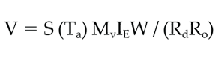
The minimum lateral earthquake force, V, shall be calculated using the following formula:
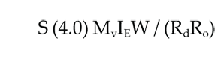
 for walls, coupled walls and wall-frame systems, V shall not be less than
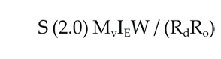
 for moment-resisting frames, braced frames, and other systems, V shall not be less than
  buildings located on a site other than Class F and having an SFRS with an Rd equal to or greater than 1.5, V need not be greater than
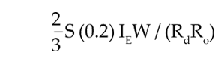 per cent of the required lateral forces and where the frame is not enclosed by or adjoined by more rigid elements that
would tend to prevent the frame from resisting lateral forces, and where
hn is in metres:for other structures, Ta shall not be taken greater than that determined in Clause (c), andin Subclauses (d)(i) to (d)(iv) may be
used, except that, for walls, coupled walls and wall-frame systems,
Ta shall not exceed 4.0 s, and for
moment-resisting frames, braced frames, and other systems, Ta
shall not exceed 2.0 s.
per cent of the required lateral forces and where the frame is not enclosed by or adjoined by more rigid elements that
would tend to prevent the frame from resisting lateral forces, and where
hn is in metres:for other structures, Ta shall not be taken greater than that determined in Clause (c), andin Subclauses (d)(i) to (d)(iv) may be
used, except that, for walls, coupled walls and wall-frame systems,
Ta shall not exceed 4.0 s, and for
moment-resisting frames, braced frames, and other systems, Ta
shall not exceed 2.0 s.
 The higher mode factor, Mv, and its associated base overturning moment reduction factor, J, shall conform to Table 4.1.8.11.
| Table 4.1.8.11. Higher Mode Factor, Mv, and Base Overturning Reduction Factor, J(1)(2) Forming part of Sentence 4.1.8.11.(5) | |||||||
|
Sa(0.2)/Sa(2.0) |
Type of Lateral Resisting Systems | Mv for Ta ≤ 1.0 | Mv for Ta = 2.0 | Mv for Ta
≥ 4.0 | J for Ta ≤ 0.5 | J for Ta = 2.0 | J for Ta ≥ 4.0 |
| < 8.0 |
Moment-resisting frames |
1.0 | 1.0 | (3) | 1.0 | 0.9 | (3) |
| Coupled walls(4) | 1.0 | 1.0 | 1.0 | 1.0 | 0.9 | 0.8 | |
| Braced frames | 1.0 | 1.0 | (3) | 1.0 | 0.8 | (3) | |
|
Walls, wall-frame systems |
1.0 | 1.2 | 1.6 | 1.0 | 0.6 | 0.5 | |
| Other systems(5) | 1.0 | 1.2 | (3) | 1.0 | 0.6 | (3) | |
| ≥ 8.0 |
Moment-resisting frames |
1.0 | 1.2 | (3) | 1.0 | 0.7 | (3) |
| Coupled walls(4) | 1.0 | 1.2 | 1.2 | 1.0 | 0.7 | 0.6 | |
| Braced frames | 1.0 | 1.5 | (3) | 1.0 | 0.6 | (3) | |
|
Walls, wall-frame systems |
1.0 | 2.2 | 3.0 | 1.0 | 0.4 | 0.3 | |
| Other systems(5) | 1.0 | 2.2 | (3) | 1.0 | 0.4 | (3) | |
| Notes to Table 4.1.8.11.: | |
|
|
|
| (1) | For values of Mv between fundamental lateral periods,
Ta, of 1.0 s and 2.0 s and between 2.0 s and 4.0 s, the product S(Ta)•Mv shall be obtained by linear interpolation.
|
| (2) | Values of J between fundamental lateral periods, Ta, of
0.5 s and 2.0 s and between 2.0 s and 4.0 s shall be obtained by linear interpolation. |
| (3) | For fundamental lateral periods, Ta, greater than 2.0 s, use the
values for Ta = 2.0. |
| (4) | A “coupled wall” is a wall system with coupling beams,
where at least 66 per cent of the base overturning moment resisted by the wall system is carried by the axial tension and compression
forces resulting from shear in the coupling beams.
|
| (5) | For hybrid systems, values corresponding to walls must be used or a dynamic analysis must be carried out as per Article 4.1.8.12. |
The total lateral seismic force, V, shall be distributed such that a portion, Ft, shall be assumed to be concentrated at the top of the building, where Ft is equal to 0.07 TaV but need not exceed 0.25 V and may be
considered as zero where the fundamental lateral period, Ta, does not
exceed 0.7 s; the remainder, V - Ft, shall be
distributed along the height of the building, including the top level, in accordance with the following formula:
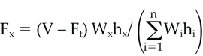 The structure shall be designed to resist overturning effects caused by the earthquake forces determined in Sentence (6) and the overturning moment at level x, Mx, shall be determined using the
following equation:
The structure shall be designed to resist overturning effects caused by the earthquake forces determined in Sentence (6) and the overturning moment at level x, Mx, shall be determined using the
following equation:
 Torsional effects that are concurrent with the effects of the forces mentioned in Sentence (6) and are caused by the simultaneous actions of the following torsional moments shall be considered in the design of the structure according to Sentence (10):and
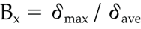 per cent of the level below need not be considered,
Torsional effects shall be accounted for as follows:or where IEFaSa(0.2) is less than 0.35, by applying torsional moments about a vertical axis at each level throughout the building, derived for each of the following load cases considered separately:4.1.8.12. Dynamic Analysis Procedure
The Dynamic Analysis Procedure shall be in accordance with one of the following methods:The spectral acceleration values used in the Modal Response Spectrum Method shall be the design spectral acceleration values,
S(T), defined in Sentence 4.1.8.4.(7). The ground motion histories used in the Numerical Integration Linear Time History Method shall be compatible with a response spectrum
constructed from the design spectral acceleration values, S(T), defined
in Sentence 4.1.8.4.(7). (See Appendix A.) The effects of accidental torsional moments acting concurrently with the lateral earthquake forces that cause them shall be accounted
for by the following methods:either determined from the elastic dynamic analysis or determined from Sentence 4.1.8.11.(6) multiplied by RdRo/IE, shall be combined with the effects determined by dynamic analysis (see Appendix A), or Except as provided in Sentence (6), the design elastic base shear, Ved, is equal to the elastic base shear,
Ve, obtained from a Linear Dynamic Analysis.
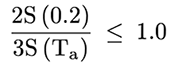
For structures located on sites other than Class F that have an SFRS with Rd equal to or greater than 1.5, the elastic base shear obtained from
a Linear Dynamic Analysis may be multiplied by the following factor to obtain the
design elastic base shear, Ved:
 The design elastic base shear, Ved, shall be multiplied by the importance factor, IE, as determined in Article 4.1.8.5., and shall be divided by RdRo, as determined in Article 4.1.8.9., to obtain the design base shear, Vd. Sentences (9) or (12), if the base shear,
Vd, obtained in Sentence (7) is less than 80 per cent of the lateral earthquake design force, V, of Article 4.1.8.11., Vd shall be taken as 0.8 V.
The design elastic base shear, Ved, shall be multiplied by the importance factor, IE, as determined in Article 4.1.8.5., and shall be divided by RdRo, as determined in Article 4.1.8.9., to obtain the design base shear, Vd. Sentences (9) or (12), if the base shear,
Vd, obtained in Sentence (7) is less than 80 per cent of the lateral earthquake design force, V, of Article 4.1.8.11., Vd shall be taken as 0.8 V.
per cent of V.
Except as required by Sentence (11), the values of elastic storey shears, storey forces, member forces, and deflections obtained from the Linear Dynamic Analysis, including the effect of accidental torsion determined in Sentence (4), shall be multiplied by Vd/Ve to determine their design values, where
Vd is the base shear.
For the purpose of calculating deflections, it is permitted to use a value for V based on the value for Ta determined in Clause 4.1.8.11.(3)(d) to obtain Vd in Sentences (8) and (9). per cent of the lateral earthquake design force, V, as determined by Article 4.1.8.11. for buildings
4.1.8.13. Deflections and Drift Limits
Lateral deflections of a structure shall be calculated in accordance with the loads and requirements defined in this Subsection.
Lateral deflections obtained from a linear elastic analysis using the methods given in Articles 4.1.8.11. and 4.1.8.12. and incorporating the effects of torsion, including accidental torsional moments, shall
be multiplied by RdRo/IE to give
realistic values of anticipated deflections.
Based on the lateral deflections calculated in Sentence (2), the largest interstorey deflection at any level shall be limited to 0.01 hs for post-disaster buildings, 0.02 hs for High Importance Category buildings, and 0.025 hs for all other buildings. The deflections calculated in Sentence (2) shall be used to account for sway effects as required by Sentence 4.1.3.2.(12). (See Appendix A.) 4.1.8.14. Structural Separation
Adjacent structures shall either be separated by the square root of the sum of the squares of their individual deflections calculated
in Sentence 4.1.8.13.(2), or shall be connected to each other. The method of connection required in Sentence (1) shall take into account the mass, stiffness, strength, ductility and anticipated motion of the connected buildings and the character of the connection. Rigidly connected buildings shall be assumed to have the lowest RdRo value of
the buildings connected. Buildings with non-rigid or energy-dissipating connections require special studies.
4.1.8.15. Design Provisions
Except as provided in Sentences (2) and (3), diaphragms, collectors, chords, struts and connections shall be designed so as not to yield, and the design shall account for the shape of the diaphragm, including openings,
and for the forces generated in the diaphragm due to the following
cases, whichever one governs (see Appendix A):Steel deck roof diaphragms in buildings of less than 4 storeys or wood diaphragms that are designed and detailed according to the applicable
referenced design standards to exhibit ductile behaviour shall meet
the requirements of Sentence (1), except that they may yield and the forces shall beWhere diaphragms are designed in accordance with Sentence (2), the struts shall be designed in accordance with Clause 4.1.8.15.(1)(a) and the collectors, chords and connections between the diaphragms and the vertical elements of the SFRS
shall be designed for forces corresponding to the capacity of the diaphragms in
accordance with the applicable CSA standards. (See Appendix A.)In cases where IEFaSa(0.2) is equal to or greater than 0.35, the elements supporting any discontinuous
wall, column or braced frame shall be designed for the lateral load
capacity of the components of the SFRS they support. (See Appendix A.) Where structures have vertical variations of RdRo satisfying Sentence 4.1.8.9.(4), the elements of the SFRS below the level where the change in RdRo occurs shall be designed for the forces associated with the lateral
load capacity of the SFRS above that level. (See Appendix A.) Where earthquake effects can produce forces in a column or wall due to lateral loading along both orthogonal axes, account shall be
taken of the effects of potential concurrent yielding of other elements
framing into the column or wall from all directions at the level under
consideration and as appropriate at other levels. (See Appendix A.) Except as provided in Sentence (8), the design forces associated with the lateral capacity of the SFRS need not exceed the forces determined in accordance with Sentence 4.1.8.7.(1) with RdRo taken as 1.0, unless otherwise provided by the applicable referenced design standards for elements, in which case
the design forces associated with the lateral capacity of the SFRS
need not exceed the forces determined in accordance with Sentence 4.1.8.7.(1) with RdRo taken as 1.3. (See Appendix A.) If foundation rocking is accounted for, the design forces for the SFRS need not exceed the maximum values
associated with foundation rocking, provided that Rd and Ro for the type of SFRS used conform
to Table 4.1.8.9. and that the foundation is designed in accordance with Sentence 4.1.8.16.(1). 4.1.8.16. Foundation Provisions
Foundations shall be designed to resist the lateral load capacity of the SFRS, except that when the foundations are allowed to rock, the design forces for the foundation need not exceed those determined in Sentence 4.1.8.7.(1) using an RdRo equal to 2.0. (See Appendix A.) The design of foundations shall be such that they are capable of transferring earthquake loads and effects
between the building and the ground without exceeding the capacities of the soil and rock. In cases where IEFaSa(0.2) is equal to or greater than 0.35, the following requirements shall
be satisfied:At sites where IEFaSa(0.2) is equal to or greater than 0.35, basement walls shall be designed to resist earthquake lateral pressures from backfill or natural ground. (See Appendix A.) per cent of its moment capacity (see Appendix A), and
Each segment of a tie between elements that is required by Clauses (3)(a) or (5)(b) shall be designed to carry by tension or compression a horizontal force at least equal to the greatest
factored pile cap or column vertical load in the elements it connects, multiplied by a factor of 0.10
IEFaSa(0.2), unless it can be demonstrated that
equivalent restraints can be provided by other means. (See Appendix A.) The potential for liquefaction of the soil and its consequences, such as significant ground displacement and loss of soil strength and stiffness, shall be evaluated based on the ground motion parameters referenced in Subsection 1.1.3. and shall be taken into account in the design
of the structure and its foundations. (See Appendix A.) 4.1.8.17. Site Stability
The potential for slope instability and its consequences, such as slope displacement, shall be evaluated based on site-specific material
properties and ground motion parameters referenced in Subsection 1.1.3. and shall be taken into account in the design
of the structure and its foundations. (See Appendix A.)4.1.8.18. Elements of Structures, Non-structural Components and Equipment
(See Appendix A.)Except as provided in Sentences (2) and (8), elements and components of buildings described in Table 4.1.8.18. and their connections to the structure shall be designed to accommodate the building deflections calculated in accordance with Article 4.1.8.13. and the element or component deflections calculated in accordance with Sentence (10), and shall be designed for a lateral force, Vp, distributed according to the distribution of mass: Table 4.1.8.4.B,For buildings other than post-disaster buildings, where IEFaSa(0.2) is less than 0.35, the requirements of Sentence (1) need not apply to Categories 6 through 21 of Table 4.1.8.18.For the purpose of applying Sentence (1) and Categories 11 and 12 of Table 4.1.8.18., elements or components shall be assumed to be flexible or flexibly connected
unless it can be shown that the fundamental period of the element
or component and its connection is less than or equal to 0.06
s, in which case the element or component is classified as
being rigid or rigidly connected.
per cent of the floor live load.
Table 4.1.8.4.B,For buildings other than post-disaster buildings, where IEFaSa(0.2) is less than 0.35, the requirements of Sentence (1) need not apply to Categories 6 through 21 of Table 4.1.8.18.For the purpose of applying Sentence (1) and Categories 11 and 12 of Table 4.1.8.18., elements or components shall be assumed to be flexible or flexibly connected
unless it can be shown that the fundamental period of the element
or component and its connection is less than or equal to 0.06
s, in which case the element or component is classified as
being rigid or rigidly connected.
per cent of the floor live load.
or the mass of a flexible or flexibly connected piece of machinery, fixture or equipment is greater than 10 per cent of the mass of the supporting floor, the lateral forces shall be determined by rational analysis.
Forces shall be applied in the horizontal direction that results in the most critical loading for design, except for Category 6 of Table 4.1.8.18., where the forces shall be applied up and down vertically.
Connections to the structure of elements and components listed in Table 4.1.8.18. shall be designed to support the component or element for gravity loads, shall conform to the requirements of Sentence (1), and shall also satisfy these additional requirements:all of the other parts of the connection, such as anchors, welds, bolts and inserts, shall be capable of developing 2.0 times the nominal yield resistance of the body of the connection, andis capable of dissipating energy through cyclic inelastic behaviour. Floors and roofs acting as diaphragms shall satisfy the requirements for diaphragms stated in Article 4.1.8.15.Lateral deflections of elements or components shall be based on the loads defined in Sentence (1) and lateral deflections obtained from an elastic analysis shall be multiplied
by Rp/IE to give realistic values of the anticipated
deflections.
The elements or components shall be designed so as not to transfer to the structure any forces unaccounted for in the design, and rigid
elements such as walls or panels shall satisfy the requirements of Sentence 4.1.8.3.(6). Seismic restraint for suspended equipment, pipes, ducts, electrical cable trays, etc. shall be designed to meet the force and displacement
requirements of this Article and be constructed in a manner that will
not subject hanger rods to bending.
Isolated suspended equipment and components, such as pendent lights, may be designed as a pendulum system provided that adequate
chains or cables capable of supporting 2.0 times the
weight of the suspended component are provided and the deflection
requirements of Sentence (11) are satisfied. | Table 4.1.8.18. Elements of Structures and Non-structural Components and Equipment Forming part of Sentence 4.1.8.18.(1) | ||||
| Category |
Part or Portion of Building |
Cp |
Ar |
Rp |
| 1 |
All exterior and interior walls except those in Category 2 or 3(1) |
1.00 | 1.00 | 2.50 |
| 2 |
Cantilever parapet and other cantilever walls except retaining walls(1) |
1.00 | 2.50 | 2.50 |
| 3 |
Exterior and interior ornamentations and appendages(1) |
1.00 | 2.50 | 2.50 |
| 4 |
Floors and roofs acting as diaphragms(2) |
- | - | - |
| 5 |
Towers, chimneys, smokestacks and penthouses when connected to or forming part of a building |
1.00 | 2.50 | 2.50 |
| 6 | Horizontally cantilevered floors, balconies, beams, etc. | 1.00 | 1.00 | 2.50 |
| 7 | Suspended ceilings, light fixtures and other attachments to ceilings with independent vertical support | 1.00 | 1.00 | 2.50 |
| 8 | Masonry veneer connections | 1.00 | 1.00 | 1.50 |
| 9 | Access floors | 1.00 | 1.00 | 2.50 |
| 10 | Masonry or concrete fences more than 1.8 m tall | 1.00 | 1.00 | 2.50 |
| 11 | Machinery, fixtures, equipment, ducts and tanks (including contents) | |||
| that are rigid and rigidly connected(3) | 1.00 | 1.00 | 1.25 | |
| that are flexible or flexibly connected(3) | 1.00 | 2.50 | 2.50 | |
| 12 |
Machinery, fixtures, equipment, ducts and tanks (including contents) containing toxic or explosive materials, materials having a flash point below 38°C or firefighting fluids |
|||
| that are rigid and rigidly connected(3) | 1.50 | 1.00 | 1.25 | |
| that are flexible or flexibly connected(3) | 1.50 | 2.50 | 2.50 | |
| 13 |
Flat bottom tanks (including contents) attached directly to a floor at or below grade within a building |
0.70 | 1.00 | 2.50 |
| 14 |
Flat bottom tanks (including contents) attached directly to a floor at or below grade within a building containing toxic or explosive materials, materials having a flash point below 38°C or firefighting fluids |
1.00 | 1.00 | 2.50 |
| 15 | Pipes, ducts, cable trays (including contents) | 1.00 | 1.00 | 3.00 |
| 16 | Pipes, ducts (including contents) containing toxic or explosive materials | 1.50 | 1.00 | 3.00 |
| 17 | Electrical cable trays, bus ducts, conduits | 1.00 | 2.50 | 5.00 |
| 18 | Rigid components with ductile material and connections | 1.00 | 1.00 | 2.50 |
| 19 | Rigid components with non-ductile material or connections | 1.00 | 1.00 | 1.00 |
| 20 | Flexible components with ductile material and connections | 1.00 | 2.50 | 2.50 |
| 21 | Flexible components with non-ductile material or connections | 1.00 | 2.50 | 1.00 |
| Notes to Table 4.1.8.18.: | |
|
|
|
| (1) | See Sentence 4.1.8.18.(8). |
| (2) | See Sentence 4.1.8.18.(9). |
| (3) | See Sentence 4.1.8.18.(4). |